Mark Kelner: American Mosaic

March 30 – May 9, 2026

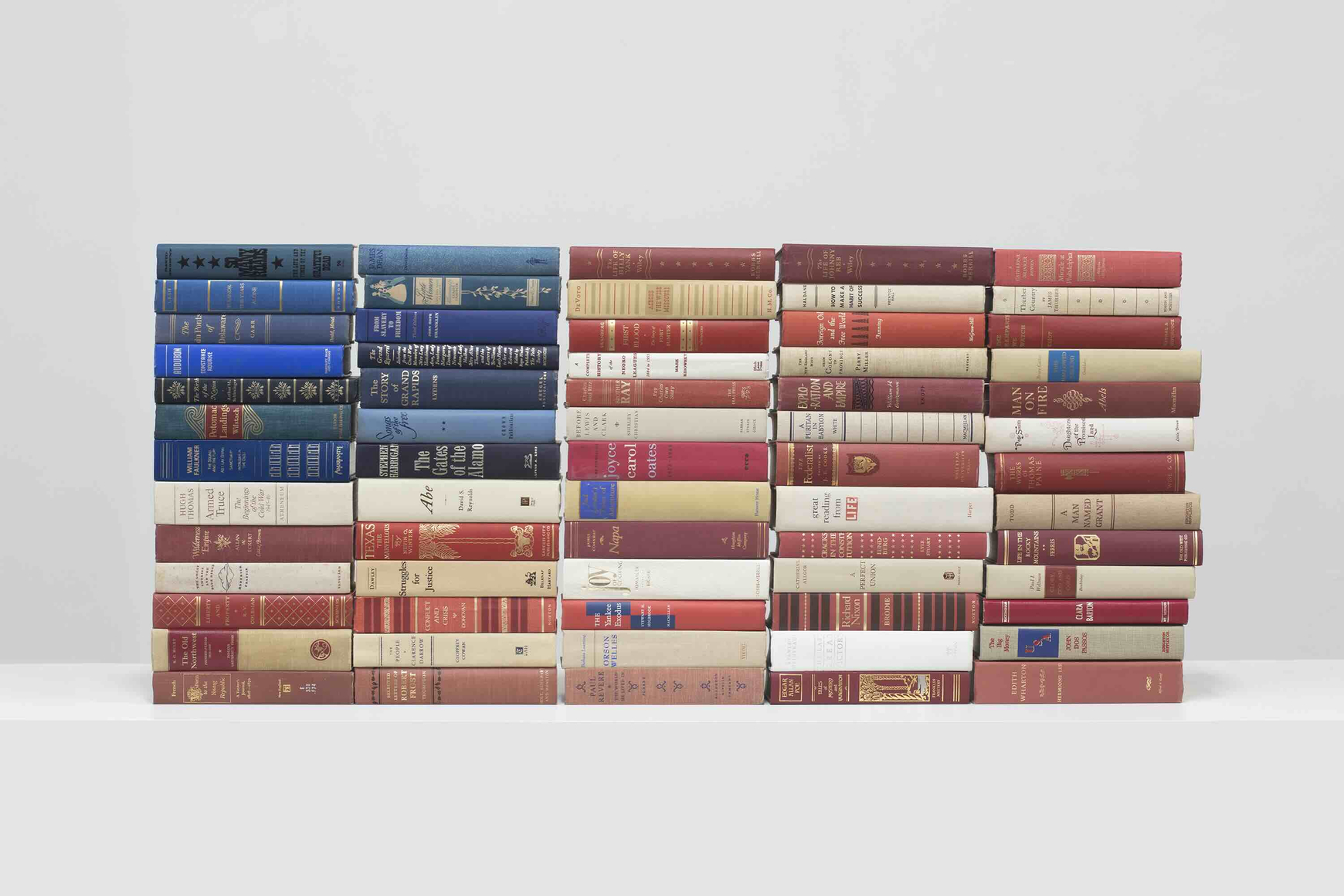
American Mosaic, 2026
found book assemblage
21 x 48 x 6 1/2 inches

Also available as:
archival matte print on hahnemuhle rag paper
20 x 30 inches
Edition of 250

"Used bookstores have long been among my most creative spaces. They are both hideaways and getaways—places to lose myself in the stacks while searching for the right tome. I was drawn to collaging secondhand books as a way of telling America’s story, embracing the character of use and reuse so the work functions almost like a quilt.

Over three years, I acquired more than 200 books and edited that down to 65, focusing on themes of history, biography, mythology, and identity. Arranged in a tiled grid with intentional gaps, the books form a flag that reflects both order and disruption, suggesting a nation, like its stories, shaped by wear, selection, and change."

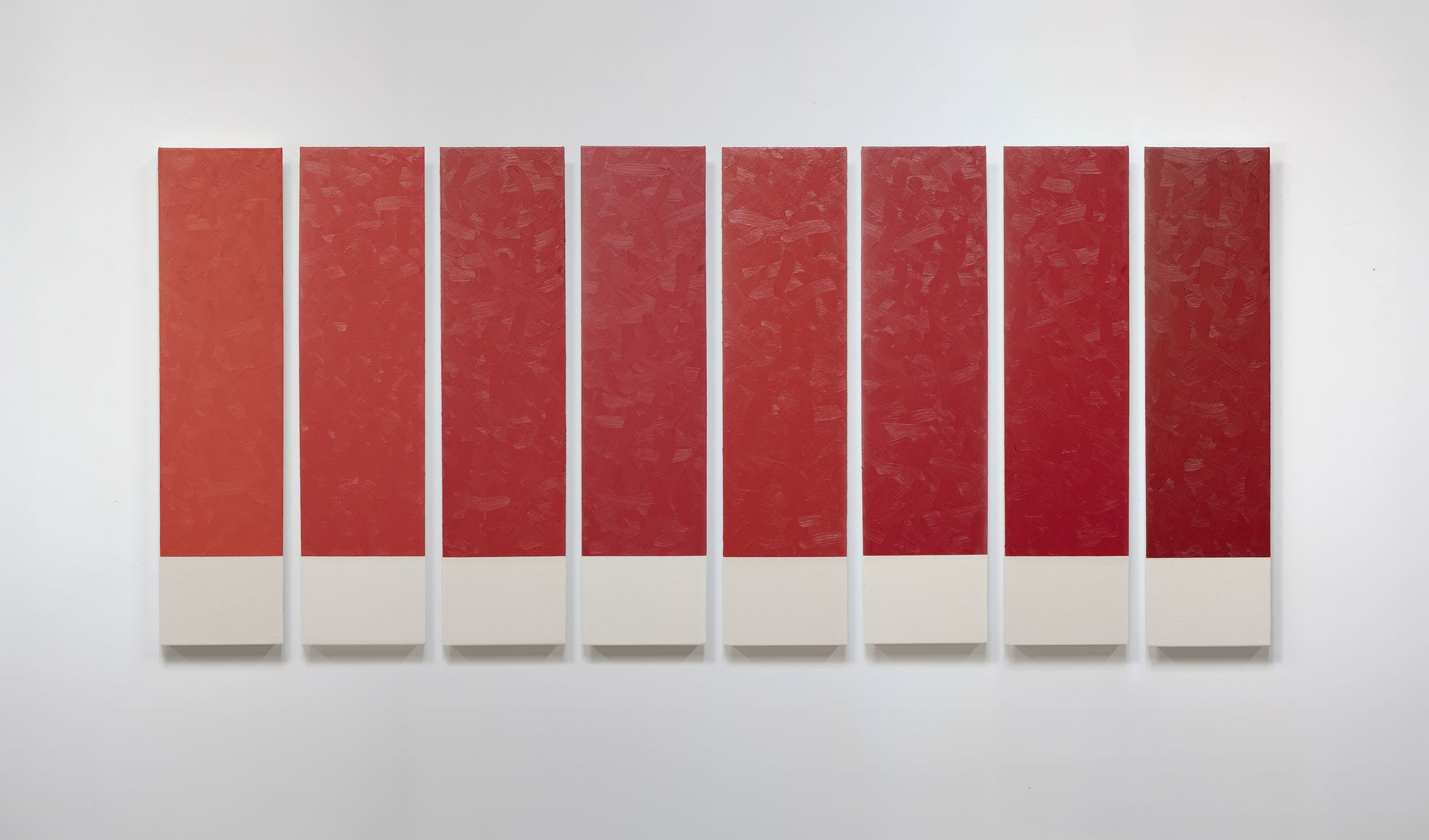
Eight American Reds, 2025
oil on canvas, eight panels
36 x 79 inches

"I designed this piece to evoke the paint swatches you find at a local hardware store. Using that familiar format, I explore desire and control; wants and needs; power and submission. Red, both pervasive and persuasive, saturates advertising so completely that we often overlook its steady pull as it quietly urges us to want, to choose, to buy. Of the three colors of the flag, it dominates our visual culture. Its influence spans from political branding (MAGA red) to everyday consumables, (cigarettes, soda, jeans, ketchup). Much like the USSR’s red flag made to evoke their revolutionary utopia, I see parallels in how consumer culture markets “happiness” through creature comforts offering up pleasure, yet at a cost. Red is beautiful and red is our collective blood."

50 Barbershop Poles, (During Covid-19), 2020
acrylic on canvas
48 x 63 inches

"During the pandemic, with few cars on the road, the commute to my studio was much faster than usual and yet, the journey felt strangely static. Rotating signs advertising businesses such as Dominican or Vietnamese barbershops, were still and unlit, signaling closures or permanent loss. “50 Still Barber Shop Poles” emerged from my desire to acknowledge this moment. The piece assigns one pole to each state, emphasizing scale as a reflection of national mood. The red, white, and blue palette further reinforces an American, collective perspective, turning a familiar commercial object into a meditation on absence, resilience, and identity, acknowledged within the nation’s most unifying and most charged symbol: the flag."

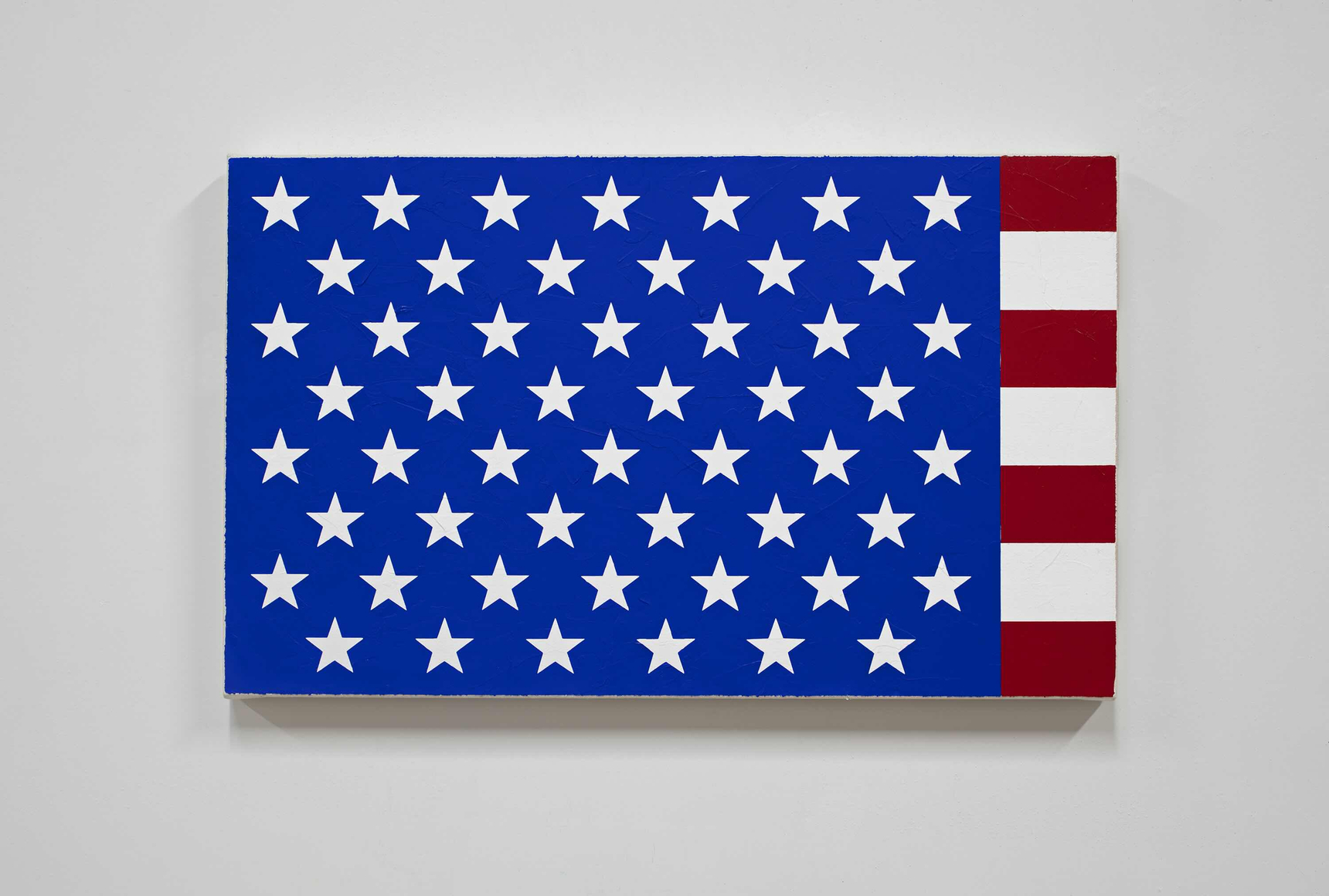
52 Stars, 2017
acrylic on canvas
17 x 28 inches

"One might not recognize “52 Stars” without its title. At first glance, it appears to be an enlarged fragment of Old Glory, and that misdirection is intentional. The image subtly distorts the familiar to evoke Washington, DC’s ambiguous constitutional status, Puerto Rico’s unequal standing, and broader contested claims to American history. Also present, if unspoken, is how race shapes inequality, underrepresentation, and access to visibility.

Through strategies of false representation and idolatry, “52 Stars” reflects the persistent politics of identity while questioning authenticity. The addition of two stars gestures toward a continuing desire to be seen and heard within entrenched structures of power and culture—and, ultimately, to be acknowledged within the nation’s most unifying and most charged symbol: the flag."

American Zippo, 2017
oil on canvas
41 x 33 inches

"As an artist based in Washington, DC, I’m aware of the influence of the Washington Color School, whose explorations of color, form, and gesture helped define the city’s visual identity. My practice engages that legacy through contemporary forms where abstraction intersects with the language of commerce.

“American Zippo” examines the commodification of “flag-ish” imagery as a marker of political identity. By isolating a three-dimensional object and flattening its form, I reframe a familiar emblem of consumer culture as a modern color field. The source image is personal: I’ve owned this Zippo lighter for years.

Removed from advertising and its utilitarian function, the object’s contours and ubiquity become the compositional focus. The result is an image that is instantly recognizable, functioning as a surrogate national symbol."

Fake, (Dedicated to Christopher Wool), 2019
acrylic on canvas
59 x 39 inches

"Christopher Wool’s (b. 1955) word paintings have shaped how artists treat language as image. Over time, I’ve watched those once-disruptive gestures turn into highly prized objects of consumption. My interest here is not in producing my own version of a stenciled pastiche, but in questioning the very nature of authenticity in a post-truth landscape. By making “Fake” the subject, the piece declares its own forgery while insisting that the forgery can still feel valid, desirable, and worth our attention. In doing so, it embraces an alternative narrative, reflecting how authorship, truth, and value are increasingly negotiated rather than fixed."

Flag, (After Jasper Johns), 2025
acrylic on canvas
9 x 13 inches

"Sold in 2010 for $110 million, Jasper Johns’s Flag (1958) is both the source of this work and a cornerstone of American pop art.

In my Barcodes series, I explore how art, once valued for mystery, intellect, and emotion, is increasingly judged by price, fame, and media presence rather than content or authorship. I trace Johns’s original lines and merge them with barcodes—universal symbols of commerce—to expose the uneasy marriage between art and capitalism. Using satire and kitsch, the work critiques the commodification of creativity, showing how repeated consumption erodes authenticity. Altered images function as both homage and interrogation, questioning how art is bought, sold, mythologized, appropriated, and disseminated in a culture that measures value in dollars as much as in meaning."

Izvestia / Fox News, 2020
screenprints on vintage Soviet newspapers
Each Sheet 17 x 12 inches

"In 2020, someone gifted me more than a dozen vintage Soviet newspapers from the 1980s, drawn from the personal collection of a former American diplomat who served in Moscow during the Cold War’s final years. I screen printed an ever-present contemporary American media logo—synonymous with propaganda and “alternative facts”—onto these papers to collapse ideological distance and historical time. The work proposes a flat circle of media power: different context, same underlying mechanism."

Jews Will Not Replace Us, 2023
tiki torches, twine
60 1/2 x 54 x 4 1/2 inches

"In response to the deadly 2017 “Unite the Right” rally in Charlottesville, I made this piece to confront anti-Semitism and affirm Jewish resistance.

The phrase “You Will Not Replace Us!” gained national attention in 2017 on white supremacist banners and graffiti, becoming a defining chant of intimidation whereby marchers carrying lit tiki torches furiously shouted out the phrase. Variants like “Jews Will Not Replace Us!” made its antisemitic meaning explicit.

This work is both a response and a call to confront white supremacy’s enduring legacy. Constructing a Star of David from tiki torches and twine, I reclaim instruments of hate as symbols of defiance, resilience, and Jewish identity, meditating on visibility, resistance, and the power of art to preserve what others wish to erase."

Mob, (Dedicated to Hans Haacke), 2015
acrylic on canvas
31 x 57 inches

"This adaptation of the Mobil Oil logo critiques the petroleum industry as, at its core, a criminal enterprise. Referencing the trademark registration, the work underscores how the mafia-like practices of the energy sector are not only systemic but, paradoxically, legally defensible. “Mob” uses corporate branding as a lens to examine the intersection of law, power, and ethical accountability at a time when environmental advocacy and public action on climate change are under threat."

Russian American Flag, II, 2017
acrylic on canvas
46 x 37 inches

"I was conceived in Russia and born in Ohio; I am both an immigrant and not an immigrant.

My work refracts overlapping, often competing national identities. In Russian American Flag, II, I explore cultural duality through abstraction. Drawing on the geometric language of Suprematism developed by Kazimir Malevich, I construct a composition that echoes the American flag while fragmenting it into seven parts.

The image moves between art history and pop culture, ideology and intentional design. I approach the work as a kind of conceptual autobiography, using Malevich’s forms to negotiate belonging, inheritance, and national symbolism.  Concurrently, the piece asks what it means to be American, Russian, or anything at all when flags function as both collective markers of identity and deeply personal icons."

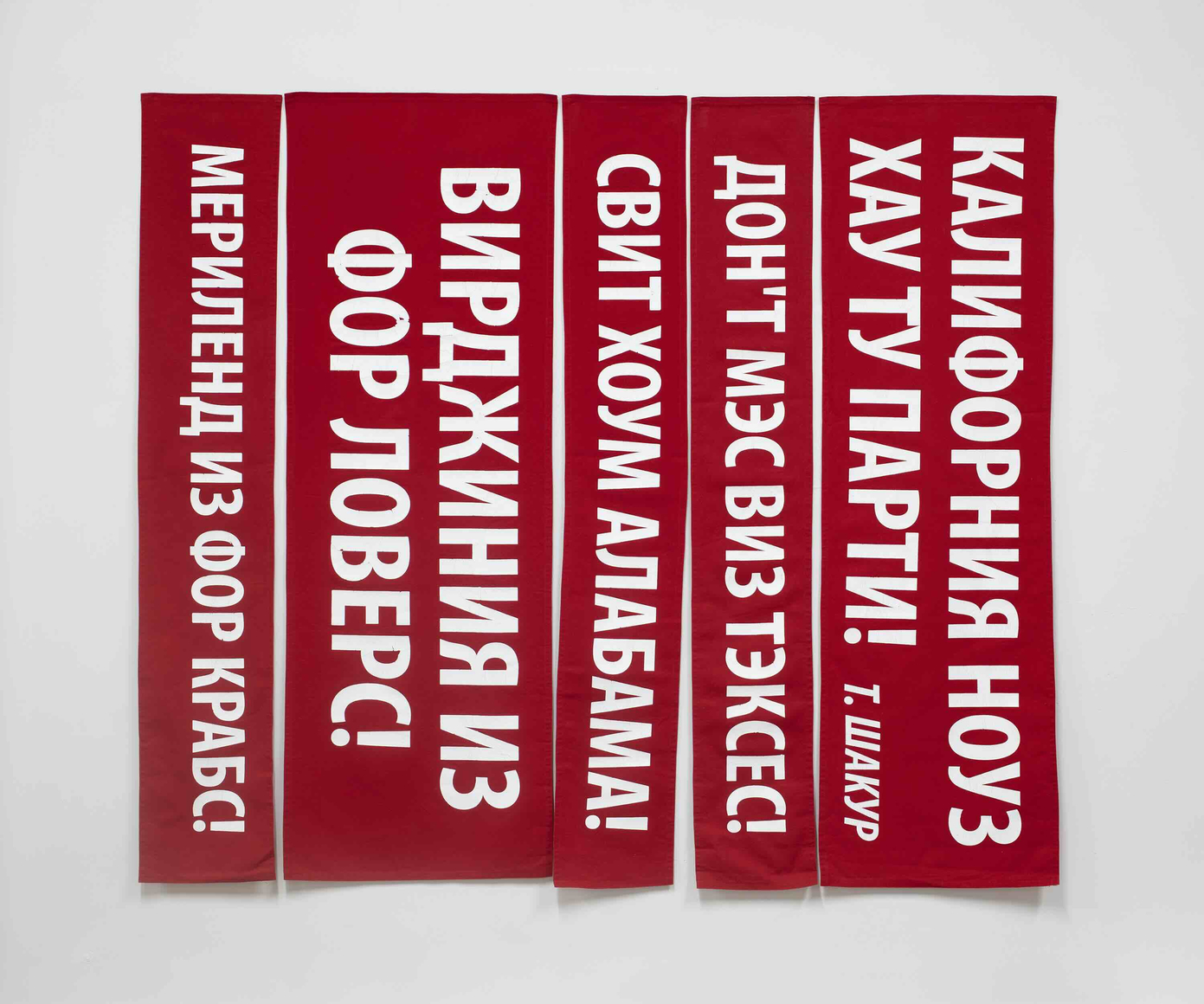
State Slogans, 2019
acrylic on cloth, five panels
70 x 80 1/2 inches

from left to right
Maryland is for Crabs!; Virginia is for Lovers!; Sweet Home Alabama!; Don’t Mess with Texas!; California Knows How to Party!

"These banners reinterpret familiar US state slogans in the visual language of Soviet propaganda—exclamation points and all. Cyrillic letters transliterate American phrases phonetically, producing text that reads in Russian as visual gibberish. Presenting these white-on-red pieces in a propaganda style historically used to justify repression and the deaths of tens of millions, the work underscores how seemingly innocuous messages are harnessed to sustain the power of tyrants."

MARK KELNER: American Mosaic | Studio Event

MARK KELNER: American Mosaic | Studio Event

Saturday, April 11, 2026 | 3 - 5 pm

Please join us for an afternoon studio event with Mark Kelner in his Mt. Rainier, Maryland studio, on the occasion of his virtual exhibition, American Mosaic.

Space is limited, RSVPs are required.

Address provided upon RSVP.

Click here to RSVP.